
Blind Contour Drawing
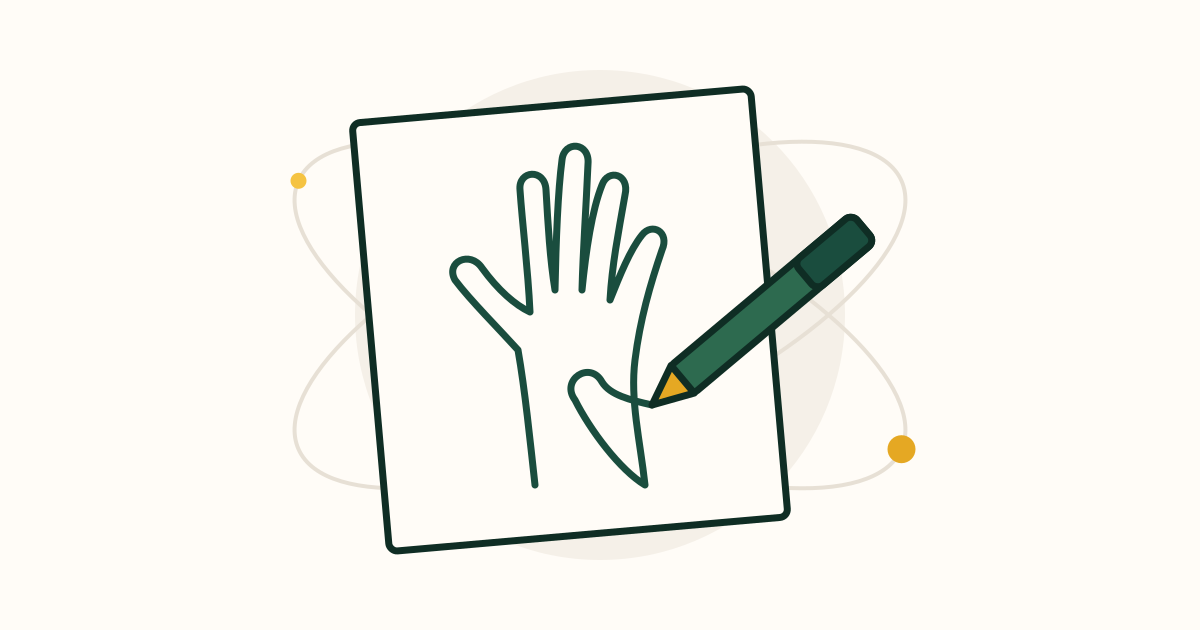
Draw an object without ever looking at your paper. Blind drawing is the fastest way to train your eye to really see, it takes one minute per drawing, and the wobbly results are part of the fun. All you need is a pen and any scrap of paper.
What you'll do
Make two one-minute blind contour drawings: your own hand and one household object.
At a glance
- Time
- 5 minutes for your first session
- Cost
- Nothing to buy. It uses things you already have at home.
- You need
- A pen, pencil or marker, Any paper, A timer (phone)
- Members
What you need
Required
- A pen, pencil or marker · $0 · household
A pen is best because you cannot erase.
- Any paper × 1-2 sheets · $0 · household
Printer paper, an envelope back or a notebook page all work.
- A timer (phone) · $0 · household
Nice to have
- A paper plate or sheet of paper to hide your drawing · $0 · household
Poke the pen through the middle to make a shield so you cannot peek.
How to do it
Pick up where you left off
Step ·
Sit at a table with the paper in front of you and tape it down or weigh one corner with a mug so it will not slide. Put your pen tip in the center of the paper. Rest your non-drawing hand on the table about 12 inches away, fingers loosely curled, and turn your chair slightly so you face that hand, not the paper. If you are tempted to look, poke your pen through a paper plate and hold the plate over your drawing hand. Set a timer for 60 seconds but do not start it yet.
Show helpHide help
Tip: Common mistake: peeking. One look breaks the exercise, because your brain switches back to drawing symbols. Use a paper plate shield if needed.
Rule one: never look at the paper until the timer ends. Rule two: never lift the pen; it is one . Rule three: your eye and the pen tip move at the same slow speed, about as fast as an ant crawls. Imagine your eye is touching the edge of your hand and your pen is recording that path. Pick a starting point, for example the tip of your thumb. The common mistake is moving the pen much faster than your eye and finishing in 10 seconds; if that happens, slow down by half.
Show helpHide help
continuous line: A drawing made without lifting the pen from the paper.
Tip: Common mistake: peeking. One look breaks the exercise, because your brain switches back to drawing symbols. Use a paper plate shield if needed.
Start the timer. Look at the tip of your thumb and slowly trace its outer edge with your eye, letting the pen follow on the paper. When you reach a crease, wrinkle or knuckle, follow it inward too; every line you see is a , not just the outline. Keep moving until the timer ends, even if you have lost track of where the pen is. Do not lift it. It worked if you spent the whole minute looking at your hand and noticed details, like a wrinkle on a knuckle, you had never really looked at before.
Show helpHide help
contour: Any edge or line you can see on a form, including inner lines like wrinkles and folds, not just the outline.
Tip: Common mistake: peeking. One look breaks the exercise, because your brain switches back to drawing symbols. Use a paper plate shield if needed.
Pick a household object with interesting edges: a mug with a handle, a pair of scissors, a set of keys or a crumpled paper towel. Place it about 12 inches away, put your pen at a fresh spot on the paper, and reset the timer for 60 seconds. Same rules: eyes on the object only, one unbroken line, slow and steady. Follow the inside edges too, like where the handle meets the mug. If your hand freezes because you do not know where you are on the paper, that is fine; keep the pen moving with your eye.
Show helpHide help
Tip: Common mistake: peeking. One look breaks the exercise, because your brain switches back to drawing symbols. Use a paper plate shield if needed.
Now look at both drawings. The proportions will be off and lines will overlap; that is expected and is the whole point. Look for the parts that feel alive: the bend of a knuckle, the curve of the handle. Circle one spot on each drawing where the line really matches what you saw. You did it: you trained your eye to follow edges instead of drawing what you think a hand looks like. Next session, try a , where you may glance at the paper once every 10 seconds, and draw your face in a mirror.
Show helpHide help
modified contour drawing: A version where you may glance at the paper briefly every few seconds to keep the drawing roughly in place.
Tip: Common mistake: peeking. One look breaks the exercise, because your brain switches back to drawing symbols. Use a paper plate shield if needed.
Tips
Common mistake: peeking. One look breaks the exercise, because your brain switches back to drawing symbols. Use a paper plate shield if needed.
Go slower than feels natural. A 60-second drawing should cover only part of the object, and that is fine.
Wrinkly, detailed subjects (hands, crumpled paper, a sneaker) are easier than smooth ones because they give your eye more to follow.
Date your drawings and keep them. After a week of one a day you will see your lines get more confident.
Glossary
- contour
- Any edge or line you can see on a form, including inner lines like wrinkles and folds, not just the outline.
- modified contour drawing
- A version where you may glance at the paper briefly every few seconds to keep the drawing roughly in place.
- continuous line
- A drawing made without lifting the pen from the paper.
Communities
Resources
- Blind contour drawing (Wikipedia)Background on the exercise and the art teachers who made it popular.
- Contour drawing (Wikipedia)How contour drawing, including blind and modified contour, fits into drawing practice.
- Proko (YouTube)Clear, beginner-friendly drawing lessons on figure, portrait and observation.
Frequently asked questions
My drawing looks nothing like my hand. Did I do it wrong?
No. Blind contour drawings almost always look distorted. The goal is training your eye to follow what is really there, not a realistic result.
Why not just look at the paper?
When you look at the paper, your brain draws its idea of a hand. Removing that option forces you to observe the real edges, which improves all your later drawing.
Do I need drawing experience?
No. This exercise is often the very first one given in drawing classes, and beginners and experts get similar-looking results.
Can I use a pencil?
Yes, but do not erase. A pen keeps you from fussing over mistakes, which helps you stay with your eye on the subject.
What should I draw next?
Your face in a mirror, a houseplant, a shoe, or a person on TV who is sitting still. Then move on to modified contour drawing.
Something off in this guide?