

Glass Harp
Tune a row of drinking glasses with water and make them sing with a wet fingertip. The glass harp, or , is a centuries-old instrument you can set up from your kitchen cupboard, and in 15 minutes you can play a simple tune by tapping and by rubbing the rims.
What you'll do
Tune 3 to 5 glasses to a scale with water, make each one ring by rubbing its rim with a wet finger, and play Hot Cross Buns or Mary Had a Little Lamb.

At a glance
- Time
- 15 minutes for your first session
- Cost
- Nothing to buy. It uses things you already have at home.
- You need
- 3 to 5 drinking glasses, A jug or bottle of water, A metal teaspoon, Soap and a towel, A flat, steady table
- Members
What you need
Required
- 3 to 5 drinking glasses × 3-5 · $0 · household
Stemmed wine glasses sing best when rubbed. Plain tumblers or jars are fine for tapping. Use glasses with no chips or cracks.
Alternatives: Glass jars or tumblers, played by tapping only
- A jug or bottle of water × About 1 liter · $0 · household
Tap water at room temperature. A measuring cup makes fine tuning easier.
- A metal teaspoon × 1 · $0 · household
For gentle tapping. A wooden spoon or chopstick gives a softer tone.
Alternatives: A pencil or chopstick
- Soap and a towel · $0 · household
Clean, oil-free fingers are what make a glass sing. Keep the towel handy for drips.
- A flat, steady table · $0 · household
Set the glasses well back from the edge, away from phones and laptops.
How to do it
Pick up where you left off
Step ·
Pick 3 to 5 glasses. Thin, stemmed wine glasses ring when rubbed; thick tumblers mostly only ring when tapped, so use wine glasses if you have them. Safety first: hold each glass up to a light and turn it slowly, looking for chips on the rim and hairline cracks. Put aside any glass with even a tiny flaw, because thin glass can crack or shatter under rubbing pressure. Set the glasses in a straight row on a flat table, about 5 cm (2 inches) apart and at least 15 cm (6 inches) from the edge. Keep phones and laptops out of splash range. Never play glasses that belong to a set someone treasures; use everyday ones.
Show helpHide help
Tip: Common mistake: pressing hard to make the glass louder. Heavy pressure chokes the sound and can crack thin glass. Lighter and steadier is louder.
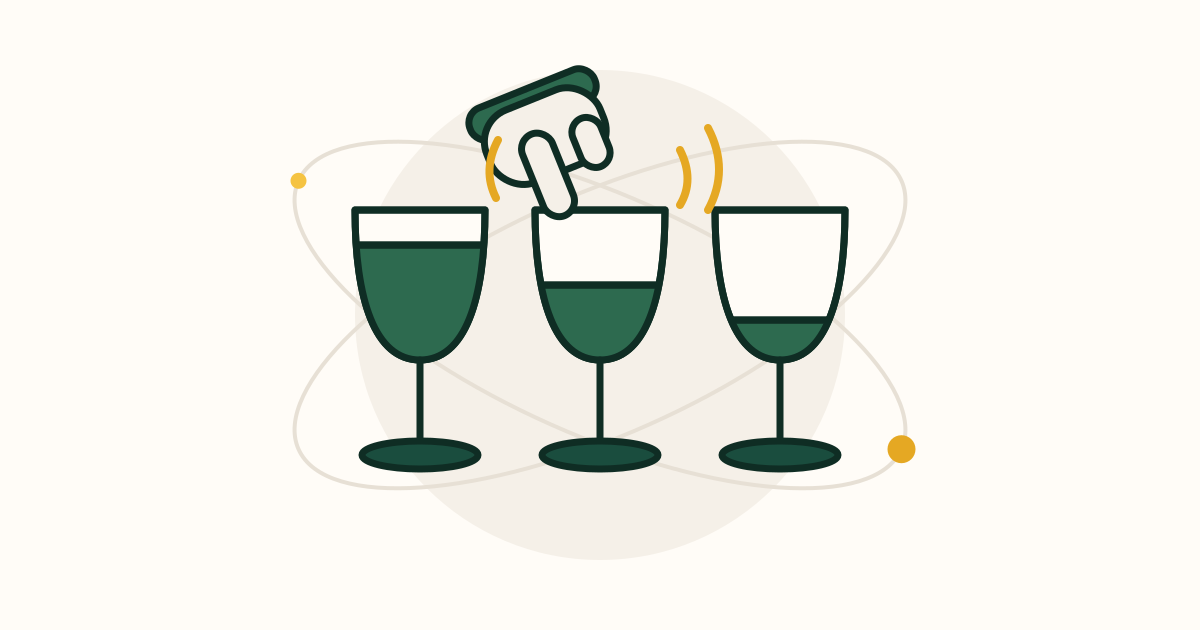
More water makes a lower . Number the glasses 1 to 5 from left to right, like piano keys going up. Fill glass 1 about three quarters full, glass 2 about two thirds, glass 3 about half, glass 4 about a third and glass 5 about a quarter. Tap each one gently on the side, near the rim, with the teaspoon. Tap lightly, with the weight of the spoon only, never a hard knock. Now sing do, re, mi, fa, sol and adjust each glass to match: if a glass sounds too high, add a spoonful of water; too low, pour a little out. Work from glass 1 upward. You are done when tapping 1 to 5 in order sounds like a rising . A free tuner app can help, but your ear is enough.
Show helpHide help
scale: A set of notes climbing in order, like do, re, mi, fa, sol.
pitch: How high or low a note sounds.
Tip: Common mistake: pressing hard to make the glass louder. Heavy pressure chokes the sound and can crack thin glass. Lighter and steadier is louder.
Wash your hands with soap and rinse well; skin oil is the most common reason a glass stays silent. Pick the glass with the least water. Hold its foot flat to the table with the spread fingers of your other hand. Dip your index or middle fingertip in water, lay the pad flat on the rim, and slide it around the rim in a steady circle, about one loop per second, with light pressure, about the weight of resting your hand on a cat. After 2 to 5 loops the squeaking turns into a clear, humming note and the water surface trembles. If it only squeaks, re-wet your finger, slow down and press a little lighter. If it never sings, wash your hands again or switch that glass to tapping.
Show helpHide help
Tip: Common mistake: pressing hard to make the glass louder. Heavy pressure chokes the sound and can crack thin glass. Lighter and steadier is louder.
Play Hot Cross Buns with glasses 3, 2 and 1, tapping gently with the spoon: 3, 2, 1, then 3, 2, 1, then 1, 1, 1, 1, 2, 2, 2, 2, then 3, 2, 1. Say the words as you go: hot cross buns, hot cross buns, one a penny, two a penny, hot cross buns. Play it 3 times until it flows. If you have 5 glasses, add Mary Had a Little Lamb: 3, 2, 1, 2, 3, 3, 3, then 2, 2, 2, then 3, 5, 5, then 3, 2, 1, 2, 3, 3, 3, 3, 2, 2, 3, 2, 1. If one note sounds wrong in the tune, it is out of tune; add or pour off a spoonful of water and try again. The common mistake is tapping too hard, which sounds clunky and risks a crack.
Show helpHide help
Tip: Common mistake: pressing hard to make the glass louder. Heavy pressure chokes the sound and can crack thin glass. Lighter and steadier is louder.
Now play Hot Cross Buns by rubbing instead of tapping. Wet the fingertips of both hands. Start each glass singing with 2 or 3 loops and keep the finger moving for as long as the note should last, then lift off and move to the next glass. Use your left hand for glasses 1 and 2 and your right hand for glass 3 so you can get the next glass ready while one is still ringing. Re-wet your fingers every few notes. Your notes will start a little late at first; that is normal, since each glass needs a moment to start ringing. You did it: you played a tune on a glass harp. Next session, add 3 more glasses to complete a full of 8 notes and try Twinkle, Twinkle, Little Star.
Show helpHide help
Tip: Common mistake: pressing hard to make the glass louder. Heavy pressure chokes the sound and can crack thin glass. Lighter and steadier is louder.
Tips
Common mistake: pressing hard to make the glass louder. Heavy pressure chokes the sound and can crack thin glass. Lighter and steadier is louder.
Safety: only play glasses with no chips or cracks, tap gently, and stop at once if you hear a buzz or see a crack. Never play crystal heirlooms.
If your fingers squeak but the glass will not sing, wash your hands again. Some players add a few drops of vinegar to their dipping water to strip skin oil.
Tune by tapping, then check by rubbing. The rubbed note is close to the tapped note, so a glass tuned one way is tuned the other.
Glossary
- musical glasses
- Another name for the glass harp: a set of glasses tuned to different notes and played by rubbing or tapping.
- scale
- A set of notes climbing in order, like do, re, mi, fa, sol.
- pitch
- How high or low a note sounds.
- glass armonica
- An instrument invented by Benjamin Franklin in 1761, with nested glass bowls spinning on a rod that the player touches with wet fingers.
Communities
Resources
- Glass harp (Wikipedia)Background on the musical glasses: how they are played with wet fingers and tuned with water or by grinding the glass.
- glassharp.org (Brien Engel)Site of glass harp musician Brien Engel, with the instrument's history and his performances on a large set of tuned glasses.
- Brien Engel (YouTube)Brien Engel's channel of glass harp performances, useful for hearing how smooth rubbed notes can sound.
Frequently asked questions
Why won't my glass make a sound when I rub it?
Usually there is oil on your finger or the glass is too thick. Wash your hands with soap, wet your fingertip, slow down and use lighter pressure. Thick tumblers rarely sing; use thin stemmed glasses for rubbing and tumblers for tapping.
Does more water make the note higher or lower?
Lower. The emptiest glass plays the highest note and the fullest plays the lowest, whether you tap or rub.
Is it safe?
Yes, with care. Use glasses with no chips or cracks, tap gently, keep pressure light, and keep the row away from the table edge and electronics. Stop if a glass buzzes or you see a crack, and clear up any broken glass with shoes on.
Do I need wine glasses?
Not for tapping, where any glasses, jars or mugs work. For rubbing, thin stemmed glasses work much better. If you only have tumblers, play this as a water-glass xylophone.
How many glasses do I need for real songs?
Eight glasses tuned to a full scale, do to the next do, play hundreds of simple tunes. Professional players use 30 to 50 glasses. Benjamin Franklin liked the sound so much that he invented the glass armonica, a spinning version you play with wet fingers.
Something off in this guide?