

House of Cards
Build a freestanding tower from nothing but playing cards, balance and . No glue, no tape and no special deck. In 15 minutes you can learn the , the move every card house is built from, and stand up a 2-story house of 7 cards.
What you'll do
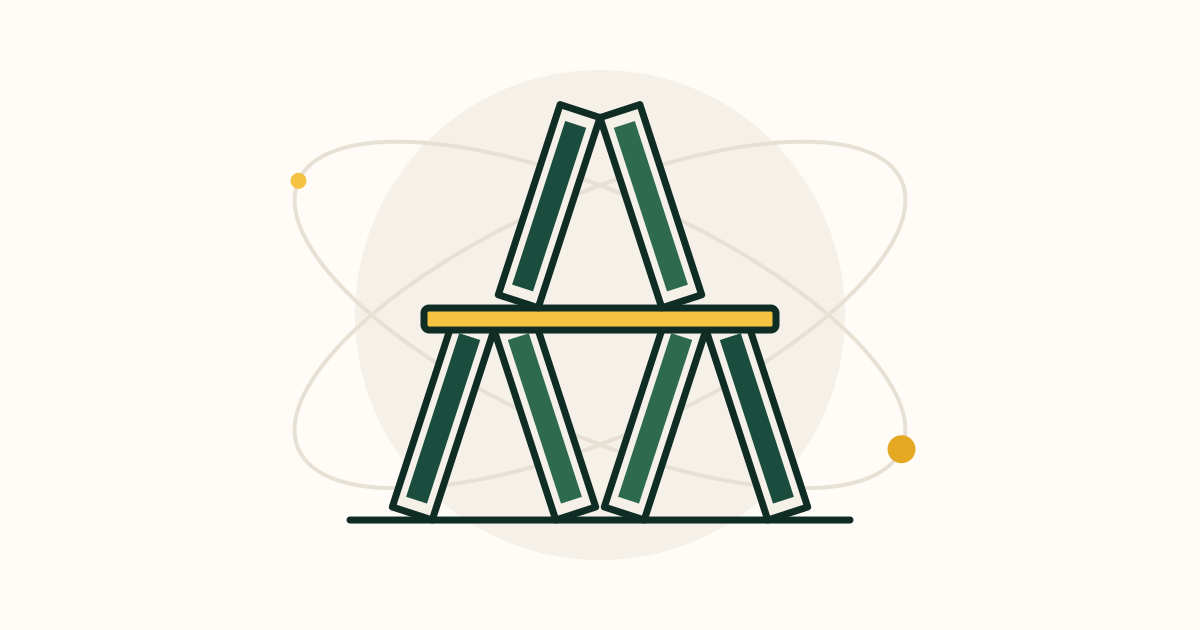
Build a 2-story house of cards from 7 cards: two A-frames, a roof card, and one more A-frame on top.

At a glance
- Time
- 15 minutes for your first session
- Cost
- Nothing to buy. It uses things you already have at home.
- You need
- A deck of playing cards, A flat surface with a little texture
- Members
What you need
Required
- A deck of playing cards × 7 cards, plus spares · $0 · household
Any standard deck. A slightly worn paper deck grips better than a brand-new glossy or plastic one.
Alternatives: Old business cards or index cards cut to card size
- A flat surface with a little texture · $0 · household
A wooden table, a short-pile carpet or a cloth placemat. Polished glass and glossy tables let the cards slide.
Alternatives: A hardcover book with a matte cover
How to do it
Pick up where you left off
Step ·
Choose a flat surface with a little grip: a plain wooden table, a cloth placemat or a short carpet. Run your fingertip across it; if it feels slick like glass, lay down a placemat. Switch off any fan, close nearby windows and keep pets away, because a single breath of air can drop a tower. Pull 7 cards from the deck for the house and keep 5 spares nearby. Pick cards that are flat; hold each one at eye level edge-on and skip any that curve. Sit so your eyes are about level with where the top of the house will be, with your elbows resting on the table. Resting elbows steady your hands far more than holding your arms in the air.
Show helpHide help
friction: The grip between two surfaces. It is the only thing holding the feet of the cards in place, which is why texture matters.
Tip: Common mistake: placing cards by sliding them into position. Every card should travel straight down and touch in its final spot, then your fingers lift straight up.
Hold one card in each hand by its top edge, the cards standing tall (short edge down). Bring the tops together so they touch along their full top edge and the cards form an upside-down V, an . Set the bottoms on the table about 2 inches (5 cm) apart, a little less than the width of a card. Keep light pressure at the top for a second, then lift your fingers straight up very slowly. It worked if it stands on its own for 10 seconds. If the bottoms slide outward and it flattens, the feet are too far apart; move them half an inch closer. If one card topples sideways, the top edges were not touching all the way along. Knock it down and build it 3 times until it feels easy.
Show helpHide help
A-frame: Two cards leaned against each other at the top in an upside-down V. Every card house is built from these.
Tip: Common mistake: placing cards by sliding them into position. Every card should travel straight down and touch in its final spot, then your fingers lift straight up.
Build another right next to the first, side by side and facing the same way, so the two peaks run parallel like the roofs of two tents in a row. Place it so the nearest feet of the two A-frames are about half an inch (1 cm) apart; do not let them touch, or building one will nudge the other. The peaks should end up about 2.5 inches (6 cm) apart, which is less than the length of a card. Check by holding a card flat above the two peaks without touching them: it should reach across both with a little to spare on each side. The most common mistake is building the second frame too far away, which leaves the nothing to rest on.
Show helpHide help
Tip: Common mistake: placing cards by sliding them into position. Every card should travel straight down and touch in its final spot, then your fingers lift straight up.
Hold one card flat by its two short edges, using your thumbs and middle fingers, with the long side running from one peak to the other. Lower it straight down, perfectly level, until it rests on both peaks, centered so the same amount hangs over each side. Let go by opening your fingers outward, not by pulling back. This flat card locks the two A-frames together and becomes the floor of the second . It worked if the whole thing stands for 10 seconds and the sits level. If it collapses, the usual cause is dropping the card from above or sliding it into place; it should touch down already in position. Your first story uses 5 cards.
Show helpHide help
roof card: A card laid flat across the peaks of two A-frames. It ties them together and is the floor for the next story.
Tip: Common mistake: placing cards by sliding them into position. Every card should travel straight down and touch in its final spot, then your fingers lift straight up.
This is the step where most houses fall, so breathe out and rest your elbows. Hold two cards as in step 2 and make the upside-down V in the air just above the center of the . Lower both cards together until the feet touch the roof card about 2 inches (5 cm) apart, centered over the gap between the two bottom A-frames. Keep the top edges pressed together, then lift your fingers away straight up, slowly. Do not press down hard; the roof card should not bend. It worked if the top stands without help. If the roof card shifts as you build, the top frame is off-center; rebuild it directly over the middle.
Show helpHide help
Tip: Common mistake: placing cards by sliding them into position. Every card should travel straight down and touch in its final spot, then your fingers lift straight up.
Take your hands away and count: 4 cards in the bottom , 1 , 2 cards in the top story, 7 cards and 2 stories. Leave it standing for 30 seconds without touching the table. Take a photo, because that is half the fun. You did it: you built a freestanding house of cards with no glue or tape. Next session, go for 3 stories with 15 cards: 3 A-frames on the bottom (6 cards), 2 roof cards, 2 A-frames (4 cards), 1 roof card and 1 on top (2 cards).
Show helpHide help
story: One level of the house: a row of A-frames, plus the roof cards on top of them if there is another level above.
Tip: Common mistake: placing cards by sliding them into position. Every card should travel straight down and touch in its final spot, then your fingers lift straight up.
Tips
Common mistake: placing cards by sliding them into position. Every card should travel straight down and touch in its final spot, then your fingers lift straight up.
Collapses are part of it. When one happens, rebuild just the part that fell instead of starting again, and you will get faster each time.
Exhale before you let go of each card, and hold your breath until it settles. It sounds silly, but it really steadies your hands.
If your deck is very slippery, rub each card lightly on your sleeve or use an older deck. Worn paper cards have more grip.
Glossary
- A-frame
- Two cards leaned against each other at the top in an upside-down V. Every card house is built from these.
- roof card
- A card laid flat across the peaks of two A-frames. It ties them together and is the floor for the next story.
- story
- One level of the house: a row of A-frames, plus the roof cards on top of them if there is another level above.
- friction
- The grip between two surfaces. It is the only thing holding the feet of the cards in place, which is why texture matters.
Communities
Resources
- House of cards (Wikipedia)History of card towers and the world records, from a 15-story tower in 1901 to Bryan Berg's 25-foot record.
- Bryan Berg, cardstackerThe world record holder's site, with photos and videos of his huge card buildings and the stories behind them.
- Building a House of Cards (Wikibooks)A free short written guide to A-frames, platforms and building upward.
Frequently asked questions
Do I need a special deck?
No. Any standard deck works. Slightly worn paper cards are easier than new glossy or plastic ones, which slide. Avoid bent cards.
It keeps falling at the top A-frame. What am I doing wrong?
Usually it is off-center or pressed down too hard. Build the V in the air above the middle of the roof card and lower it gently. Also check for drafts and rest your elbows on the table.
Is it cheating to use glue or tape?
For a classic house of cards, yes: it stands on balance and friction alone. Record builds also ban altered cards. Glue is fine for a display piece you want to keep.
How many cards do I need for a bigger house?
A pyramid needs 2 cards for one story, 7 for two, 15 for three, 26 for four and 40 for five. One deck of 52 is enough for five stories.
What is the world record?
Bryan Berg built the tallest house of cards, 25 feet 9 7/16 inches (7.86 m), at the State Fair of Texas in 2007.
Something off in this guide?