

Morse Code
Morse code spells every letter with short and long signals, dots and dashes, that you can tap, flash or hum. In 5 minutes you can learn and the letters of your own initials, and tap a short message to someone with a fingertip or a phone flashlight.
What you'll do
Learn the rhythm of dots and dashes, send SOS, look up your initials, and tap your initials plus HI to a partner who decodes them.
At a glance
- Time
- 5 minutes for your first session
- Cost
- Nothing to buy. It uses things you already have at home.
- You need
- Your fingertip
- Members
What you need
Required
- Your fingertip · $0 · household
You will tap on a partner's hand or forearm, where they can feel short and long touches.
Alternatives: Your phone's flashlight, Humming or saying dit and dah out loud
Nice to have
- A partner × 1 person · $0 · household
Someone to receive and decode your message. On your own, tap on your own knee and say the sounds out loud.
- Paper and pen × 1 scrap · $0 · household
Handy for writing down your initials' codes and for your partner to decode.
Alternatives: A screenshot of the letter list on this page
How to do it
Pick up where you left off
Step ·
Morse code has only two signals. A dot is a short signal; say it as . A dash is a long signal, exactly 3 times as long as a dot; say it as . Rest your fingertip on the back of your other hand. For a dot, press and lift at once. For a dash, press and hold while you silently count one-two-three, then lift. Do 5 dots, then 5 dashes, saying dit or dah each time. You know it is working when every dash clearly feels three times longer than a dot. The most common mistake is making dashes too short, so they blur into dots. If they sound the same when you say them, slow down and stretch each dah.
Show helpHide help
dit: The spoken sound of a dot, the short signal. Inside a letter, dits are often shortened to di, as in di-dah for A.
dah: The spoken sound of a dash, the long signal, three times as long as a dot.
Tip: Common mistake: learning the letters as pictures of dots and dashes. Say them as sounds, dit and dah, from the start. Real Morse is heard or felt, not read.
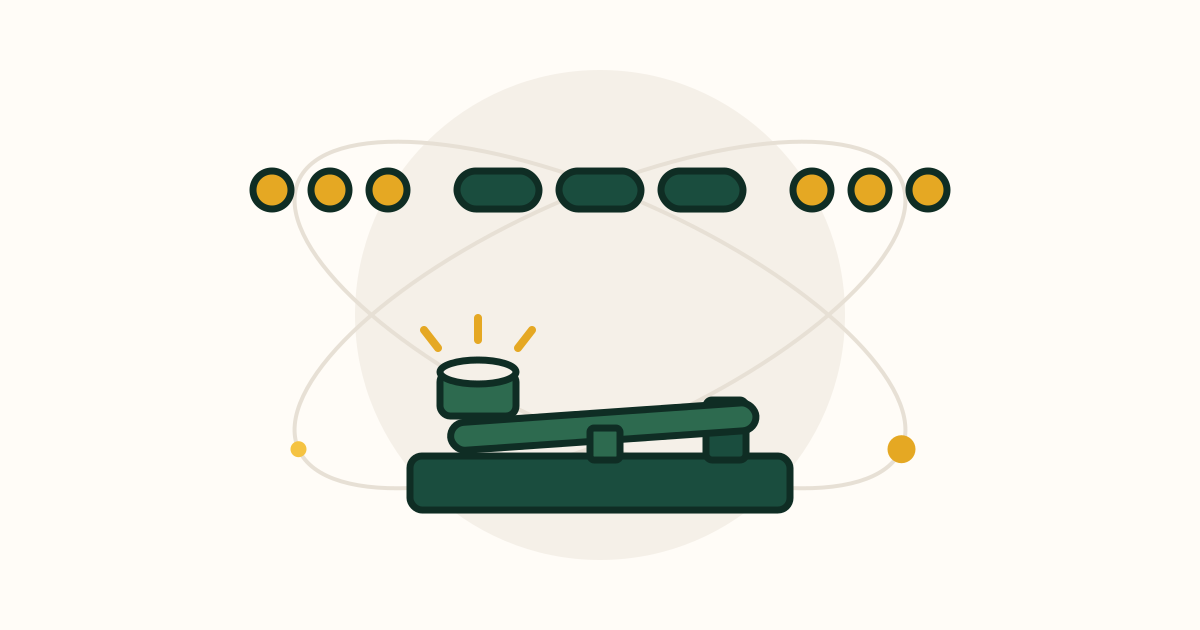
S is three dots and O is three dashes. is dit-dit-dit, dah-dah-dah, dit-dit-dit: 9 signals, short-short-short, long-long-long, short-short-short. Inside a letter, leave a gap the length of one dot between signals. Between letters, leave a gap of three dots, about one beat of silence. Tap SOS on the back of your hand 3 times while saying it out loud. Operators send SOS as a , one unbroken run without letter gaps, but beginners are understood either way. It works when someone could count 3, 3 and 3. The common mistake is rushing the dashes in the middle; keep them long and even.
Show helpHide help
prosign: A group of letters sent as one unbroken signal with no gaps, used for special meanings. SOS is the best-known one.
SOS: The international distress signal. It does not stand for any words; it was chosen in 1906 because its pattern is easy to send and recognize.
Tip: Common mistake: learning the letters as pictures of dots and dashes. Say them as sounds, dit and dah, from the start. Real Morse is heard or felt, not read.
In this list a period is a dot and a hyphen is a dash. A .-, B -..., C -.-., D -.., E ., F ..-., G --., H ...., I .., J .---, K -.-, L .-.., M --, N -., O ---, P .--., Q --.-, R .-., S ..., T -, U ..-, V ...-, W .--, X -..-, Y -.--, Z --... Find the letters of your initials and write them down with their codes. Example: for the initials M and L, write M -- and L .-.. (dah-dah, then dit-dah-dit-dit). Also write HI: H .... and I .. so you have a message to send. Say each one out loud 3 times. Check your work by reading the code back to a letter from the list.
Show helpHide help
Tip: Common mistake: learning the letters as pictures of dots and dashes. Say them as sounds, dit and dah, from the start. Real Morse is heard or felt, not read.
Ask your partner to hold out a hand palm down. Tap HI on the back of their hand: dit-dit-dit-dit, pause, dit-dit. Then leave a longer pause, about 7 dots long or two slow breaths, which marks a new word, and tap your initials. Your partner writes a dot or dash for each touch and a slash at every pause, then decodes using the list on this page. It worked if they read back HI and your initials. The most common mistake is pauses that are too short, which makes letters run together: H and I tapped with no gap look like 6 dots, which is not a letter at all. If you are alone, flash it with your phone flashlight in a mirror, or tap it on your knee while saying the sounds.
Show helpHide help
Tip: Common mistake: learning the letters as pictures of dots and dashes. Say them as sounds, dit and dah, from the start. Real Morse is heard or felt, not read.
Now let your partner pick one letter from the list and tap it on your hand while you close your eyes. Count the signals and their lengths, write them down, and look up the letter. Try 3 letters. Start with E (one dot) and T (one dash), the two shortest codes, then something longer like A (dit-dah). You will notice receiving is harder than sending; that is normal for everyone. You did it: you sent a distress call, your own initials and a greeting in a code used for nearly 200 years. Next session, learn the six most common letters by sound, E T A O I N, and tap your whole first name.
Show helpHide help
Tip: Common mistake: learning the letters as pictures of dots and dashes. Say them as sounds, dit and dah, from the start. Real Morse is heard or felt, not read.
Tips
Common mistake: learning the letters as pictures of dots and dashes. Say them as sounds, and , from the start. Real Morse is heard or felt, not read.
Keep the 1-3-7 rhythm: a dash is 3 dots long, a gap between letters is 3 dots, and a gap between words is 7 dots.
Opposite letters make good pairs to learn together: A is dit-dah and N is dah-dit, D is dah-dit-dit and U is dit-dit-dah.
A phone flashlight works well across a dark room. Cover and uncover it with your palm instead of switching it on and off, which is too slow.
Glossary
- dit
- The spoken sound of a dot, the short signal. Inside a letter, dits are often shortened to di, as in di-dah for A.
- dah
- The spoken sound of a dash, the long signal, three times as long as a dot.
- prosign
- A group of letters sent as one unbroken signal with no gaps, used for special meanings. SOS is the best-known one.
- SOS
- The international distress signal. It does not stand for any words; it was chosen in 1906 because its pattern is easy to send and recognize.
Communities
Resources
- Learning Morse Code (ARRL)The national amateur radio association's page of free courses, training apps and practice recordings.
- Morse Code Translator (MorseCode.World)Type any message to see it in Morse and play it back as sound or a flashing light, at adjustable speed.
- Morse code (Wikipedia)History of the code, the full chart of letters, numbers and punctuation, and the timing rules.
Frequently asked questions
Is Morse code still used?
Yes. Amateur radio operators all over the world use it every day, and it is still a recognized way to signal for help with a light or by tapping. Some people with limited movement also use it to type.
How long does it take to learn the whole alphabet?
Most people can learn all 26 letters by sound in a few weeks with 10 to 15 minutes a day. Learning two or three new letters per session works better than trying to memorize the whole list at once.
Do I need a license?
Not to learn it or tap it to a friend. You only need an amateur radio license to send Morse code over the radio.
My partner can't tell my letters apart. What's wrong?
Almost always the gaps. Make the pause between letters as long as a dash and the pause between words more than twice that. Slower, clearer gaps beat faster tapping.
What about numbers?
Every digit has 5 signals. 1 is one dot and four dashes, 2 is two dots and three dashes, up to 5, which is five dots. 6 is one dash and four dots, up to 0, which is five dashes.
Something off in this guide?