

Rubber Band Guitar
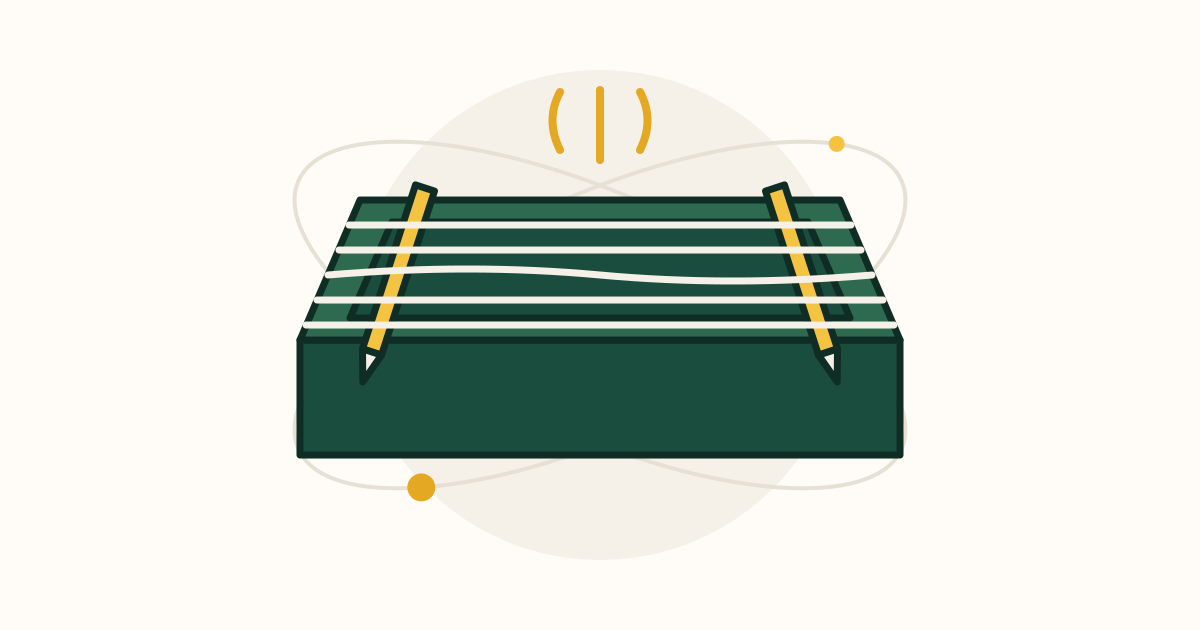
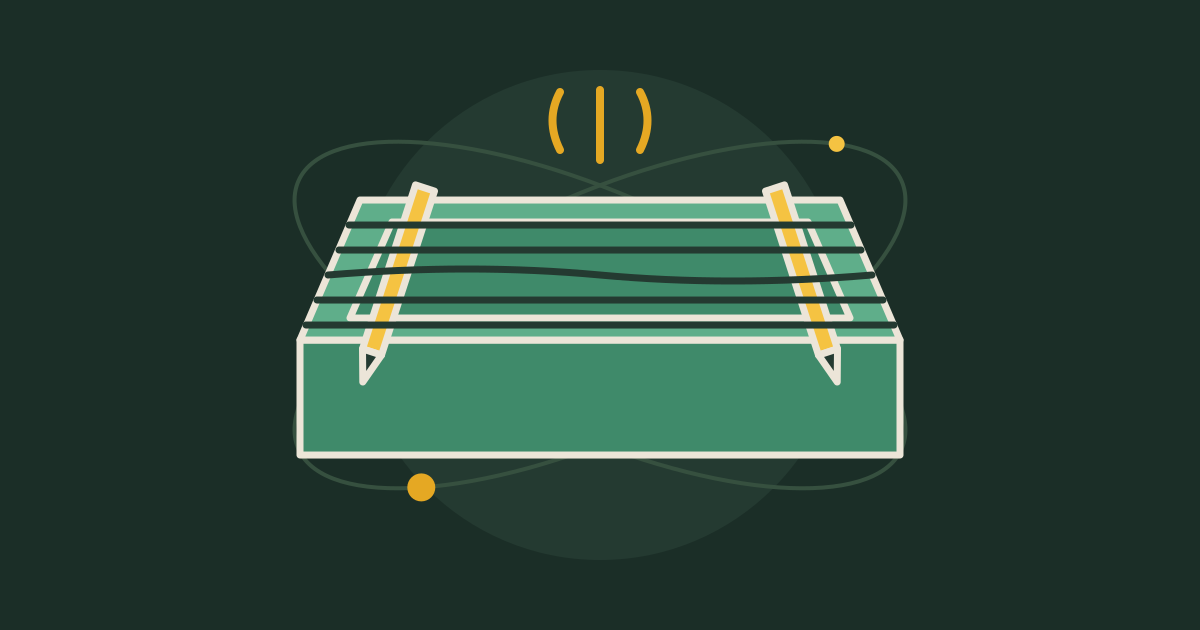
Stretch a few rubber bands over an open box, lift them on a pencil, and you have a little stringed instrument that twangs like a toy guitar. Thick bands play low, thin ones play high, and a slanted pencil turns the row into a rough . It uses what you have, and in one sitting you go from an empty box to plucking a real three-note tune.
What you'll do
Wrap 4 to 6 rubber bands of different thicknesses around an open box, slide a pencil under them at each end as bridges, tune them low to high by thickness, tension and a slanted bridge, then pluck "Hot Cross Buns" on three of them.
At a glance
- Time
- 15 minutes for your first session
- Cost
- Nothing to buy. It uses things you already have at home.
- You need
- An open box or container, Rubber bands of different thicknesses, Two pencils or pens
- Members
What you need
Required
- An open box or container × 1, about tissue-box size · $0 · household
A tissue box with its hole, a plastic food tub, or a shoebox with the lid off all work. Office rubber bands usually reach around a tissue box or small tub the long way; a shoebox needs long or wide bands. It needs stiff sides that don't fold in when the bands pull on them. The open top or hole lets the box ring like a guitar body; a closed box works but sounds quieter.
Alternatives: Shoebox with the lid off (needs longer bands), Plastic takeout tub or food storage box, Small baking tin
- Rubber bands of different thicknesses × 4 to 6 · $0 · household
Mix thin and thick ones if you can, such as office bands plus the wide bands from broccoli or mail. Each must reach around the box the long way, snug but not stretched to its limit; if your bands are short, pick a smaller box. Throw out any that are sticky, cracked or brittle; old bands snap.
Alternatives: Hair ties for the lowest notes
- Two pencils or pens × 2 · $0 · household
They lift the bands off the box as bridges. Round or six-sided pencils, pens, markers or chopsticks all work. They should be at least as long as the box is wide.
Alternatives: Chopsticks, Markers
Nice to have
- A strip of tape × 2 short pieces · $0 · household
Holds a pencil in place if it keeps rolling. Any tape works.
How to do it
Pick up where you left off
Step ·
Set the box open side up with a long side facing you. Hold it at arm's length, away from your face, and stretch the first band around it the long way, so it runs over the open top from one short end to the other and under the bottom. Add the rest the same way, about 2 cm (3/4 inch) apart, thickest band farthest from you and thinnest nearest, like a guitar seen from above. If a band only reaches by stretching to its limit, leave it out and use a bigger band or a smaller box; don't turn it the short way, because the pencils only lift bands that run the long way. It worked if every band lies straight across the opening and feels taut, like a bow string, when you press it with a finger. Common mistake: bands that sag. A slack band only thuds; swap it for a smaller one or wrap it twice.
Show helpHide help
Tip: Common mistake: using the oldest bands in the drawer. Sticky or cracked bands snap when stretched and sound dull. Keep your face away when stretching any band.
Lift the bands with one finger and slide a pencil under all of them, crossways, about 3 cm (1 1/4 inches) in from the left end of the box. Do the same with the second pencil 3 cm in from the right end. The bands should now float above the opening, touching only the two pencils between the ends. Press a strip of tape over each pencil end if it rolls. Pluck each band once in the middle by pulling it 1 cm sideways and letting go. It worked if each band rings with a clear twang for about a second, louder than before. Common mistake: a band still touching the rim of the box between the pencils. It buzzes and dies at once; slide the band along the pencil, or swap in a fatter pen or marker as the .
Show helpHide help
bridge: The piece that lifts the strings off the body so they can vibrate freely. Here it is a pencil.
Tip: Common mistake: using the oldest bands in the drawer. Sticky or cracked bands snap when stretched and sound dull. Keep your face away when stretching any band.
Pluck from the farthest band to the nearest. The thick bands usually sound lower and the thin ones higher, though how far each band is stretched matters too. Now try the three things that change a note. Thickness: a thinner band is higher. : press a band down with a fingertip just outside the left pencil, between the pencil and the end of the box, and pluck while you press; tighter is higher. Length: press a fingertip firmly on a band halfway between the pencils and pluck the half nearer the right pencil; shorter is higher. It worked if you can hear each change raise the note. Common mistake: plucking too hard. A big pull makes the band slap the box and flattens the note; 1 cm is plenty.
Show helpHide help
pitch: How high or low a note sounds.
tension: How tightly a band is stretched. More tension gives a higher note.
vibrating length: The part of a band between the two bridges, the only part that sings when you pluck it.
Tip: Common mistake: using the oldest bands in the drawer. Sticky or cracked bands snap when stretched and sound dull. Keep your face away when stretching any band.
Slant the right pencil: move its end nearest you about 4 cm (1 1/2 inches) toward the middle, so the near bands get shorter and higher. Pick three neighboring bands and name them 1 (lowest), 2 and 3 (highest). Sing "do, re, mi" and pluck 1, 2, 3 along with it. If two sound the same, adjust: slide the slanted pencil a little, swap a band for a thinner or thicker one, or wrap a loose one twice. Rubber bands never tune perfectly; you want three notes that clearly step up, like the first three notes of a . It worked if plucking 1, 2, 3 sounds like walking up three stairs. Common mistake: tuning by eye. Bands that look different can sound alike, so always pluck and listen.
Show helpHide help
scale: A row of notes that steps up in order, sung as do, re, mi, fa, sol, la, ti, do.
Tip: Common mistake: using the oldest bands in the drawer. Sticky or cracked bands snap when stretched and sound dull. Keep your face away when stretching any band.
Play it on your three bands, one pluck per number, a little slower than you would sing it: 3, 2, 1 (hot cross buns); 3, 2, 1 (hot cross buns); 1, 1, 1, 1, then 2, 2, 2, 2, quickly (one a penny, two a penny); 3, 2, 1 (hot cross buns). After each pluck, rest a fingertip on the band you just played if it rings into the next note. Play it 3 times. You did it: you built a stringed instrument from a box and played a tune on it. Next session, tune two more bands to fa and sol (numbers 4 and 5) and play "Mary Had a Little Lamb": 3 2 1 2 3 3 3, 2 2 2, 3 5 5.
Show helpHide help
Tip: Common mistake: using the oldest bands in the drawer. Sticky or cracked bands snap when stretched and sound dull. Keep your face away when stretching any band.
Tips
Common mistake: using the oldest bands in the drawer. Sticky or cracked bands snap when stretched and sound dull. Keep your face away when stretching any band.
Pluck halfway between the pencils for the fullest sound, and near a pencil for a brighter, thinner twang.
A box with a hole in the top sounds louder than a closed one, because the air inside rings along with the bands. Try a tissue box or cut a hole about 8 cm (3 inches) across in a shoebox lid.
Bands loosen and go flat as they warm up and stretch. Retune by ear at the start of each session.
Glossary
- bridge
- The piece that lifts the strings off the body so they can vibrate freely. Here it is a pencil.
- pitch
- How high or low a note sounds.
- tension
- How tightly a band is stretched. More tension gives a higher note.
- vibrating length
- The part of a band between the two bridges, the only part that sings when you pluck it.
- scale
- A row of notes that steps up in order, sung as do, re, mi, fa, sol, la, ti, do.
Communities
Resources
- Make a Rubber Band Guitar (Science Buddies)The same build on a tissue box, with a clear explanation of why thickness, tension and vibrating length change the pitch.
- How to Make a Recycled DIY Guitar (Highlights)A shoebox version with a sound hole and two pencil bridges, plus a paper-towel-tube neck to add later.
Frequently asked questions
How long does it take to make a rubber band guitar?
About 5 minutes to build and 10 to tune it and play a first tune. Kids can do it with a grown-up holding the box while bands go on.
What kind of box works best?
A sturdy box with an open top or a hole, such as a shoebox without its lid or a tissue box. Thin cereal boxes fold in under the pull of the bands, and closed boxes sound quieter.
Why does a band only make a dull thud?
It is too loose, or it is touching the box between the pencils. Use a smaller band or wrap it twice, and make sure it rests only on the pencils.
Why do two different bands sound the same?
A thicker band stretched tighter can match a thinner, looser one. Slide the slanted pencil, tighten one band, or swap it until each one steps up from the last.
Can it really play in tune?
Roughly. Rubber stretches and changes as it warms, so notes drift. It is close enough for simple tunes by ear, not for playing along with a real guitar.
Something off in this guide?