

Ultimate Tic-Tac-Toe
Nine games of tic-tac-toe inside one big one, where every move decides where your opponent must play next. It takes a pen, a sheet of paper and one friend, and in 15 minutes you can draw the board, learn the , and play your first full game.
What you'll do
Draw the 81-square board, learn the send rule and the free-move rule, and play one full game against a friend.
At a glance
- Time
- 15 minutes for your first session
- Cost
- Nothing to buy. It uses things you already have at home.
- You need
- A sheet of paper, A pen or pencil, A second player
- Members
What you need
Required
- A sheet of paper × 1 per game · $0 · household
A full letter or A4 sheet gives room for 81 squares. Graph paper makes the grids quick.
Alternatives: A whiteboard
- A pen or pencil × 1, or 2 in different colors · $0 · household
Two colors, one for X and one for O, make the board much easier to read.
- A second player × 1 person · $0 · household
Anyone who knows ordinary tic-tac-toe can learn this in a few minutes.
Alternatives: Play both sides yourself to learn the rules
How to do it
Pick up where you left off
Step ·
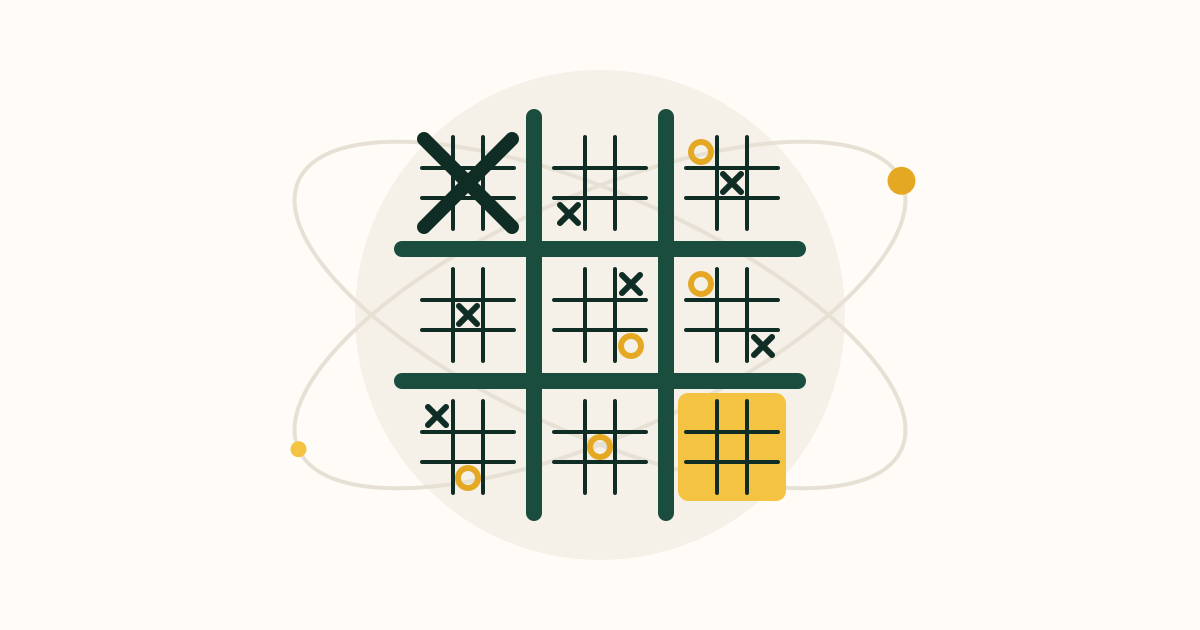
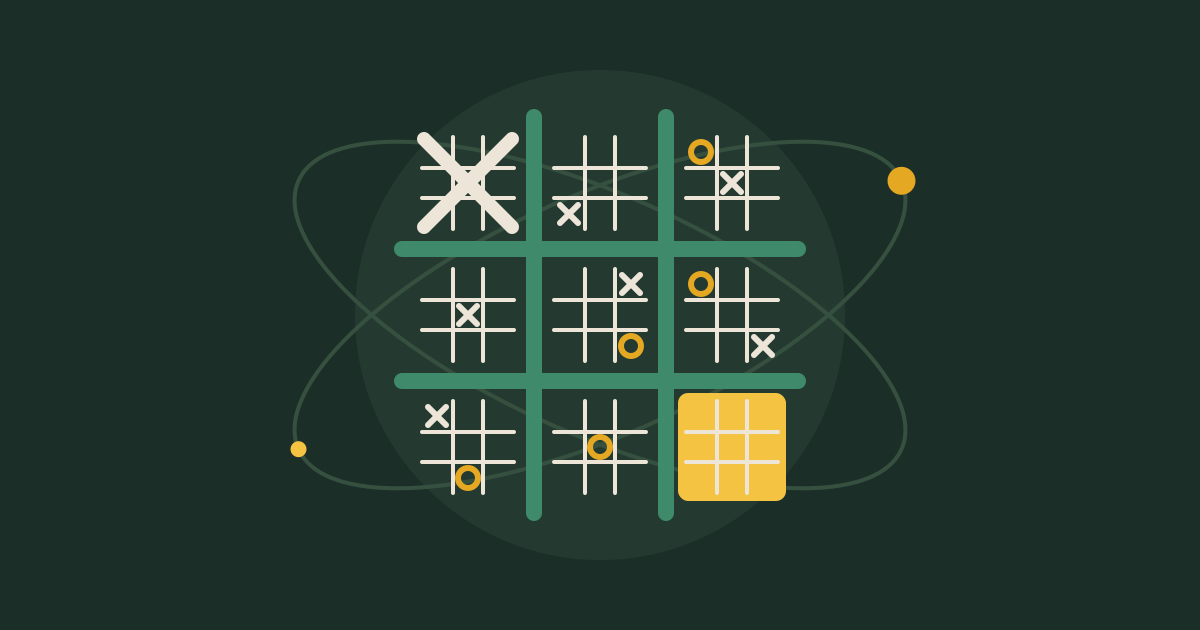
Draw a large tic-tac-toe grid that fills most of the page: two long lines down and two across, pressing hard so they are thick. That makes 9 big cells. Inside each big cell, draw a small tic-tac-toe grid with thin lines, leaving a margin of about a finger-width so the small grids do not touch the big lines. You now have 9 small boards and 81 squares. You know it is right when you can clearly see the big 3-by-3 shape at a glance. The most common mistake is small grids that crowd the big lines, which makes it hard to tell which board a mark is in. Decide who is X; X goes first.
Show helpHide help
small board: One of the 9 ordinary tic-tac-toe grids inside the big board.
Tip: Common mistake: chasing three in a row on one small board while ignoring where each move sends your opponent. The send is usually more important than the square.
This is the whole trick. The square you pick inside a decides which small board your opponent must play in next. Each small board has the same 9 positions as the big board: top-left, top-middle, top-right, and so on down to bottom-right. X's very first move can go anywhere. Example: X plays in the top-right square of the center board, so O must play somewhere in the top-right board. If O then plays the bottom-left square of that board, X must play in the bottom-left board. The most common mistake is sending to the board you played in, rather than the board that matches the square. Say it out loud each turn: top-right square, top-right board.
Show helpHide help
send rule: The rule that the square you play in decides which small board your opponent must play in next.
Tip: Common mistake: chasing three in a row on one small board while ignoring where each move sends your opponent. The send is usually more important than the square.
Three in a row on a , across, down or diagonally, wins that board. Draw one big X or O over the whole small board so it is easy to see. Once a board is won, nobody plays in it again. If a board fills up with no winner, it is and counts for no one. The : if the points you to a board that is already won or full, you may play in any open square on any other board. That freedom is a gift, so try never to send your opponent to a finished board. Play the first 10 moves of a game now, checking the send rule on every move. If you are unsure where you are allowed to play, point at the square your opponent just played and find the matching board.
Show helpHide help
free-move rule: If you are sent to a board that is already won or full, you may play in any open square on any other board.
tied: A small board that fills up with no three in a row. It counts for neither player. Some people agree beforehand to count it for both.
Tip: Common mistake: chasing three in a row on one small board while ignoring where each move sends your opponent. The send is usually more important than the square.
You win the whole game by winning three small boards in a row on the big board, across, down or diagonally, exactly like regular tic-tac-toe at a bigger scale. If no one can make three in a row any more, the game is a draw. Look at your board now: which small boards has each player won, and does anyone have two in a row on the big grid? Here is the key idea: winning a matters less than which board you send your opponent to. A move that wins you a square but sends your opponent to a board where they can win is often a bad move.
Show helpHide help
Tip: Common mistake: chasing three in a row on one small board while ignoring where each move sends your opponent. The send is usually more important than the square.
Finish the game, using three simple habits. First, before every move, look at the board your move will send your opponent to and check whether they could win it straight away; if so, pick a different square. Second, avoid sending your opponent to a won or full board, which gives them a free move anywhere. Third, early on, avoid playing the center square of small boards too often, because every center square sends your opponent to the center board, and that is the most valuable board. A first game takes about 5 to 8 minutes. You did it: you played a full game of 81-square tic-tac-toe on one sheet of paper. Next session, play a rematch with the other player going first and keep a tally.
Show helpHide help
Tip: Common mistake: chasing three in a row on one small board while ignoring where each move sends your opponent. The send is usually more important than the square.
Tips
Common mistake: chasing three in a row on one while ignoring where each move sends your opponent. The send is usually more important than the square.
Lightly dot or circle the board your opponent must play in after each move. It prevents arguments and helps beginners see the rule.
Use two pen colors, one for X and one for O, so the 81 squares stay readable at the end of a long game.
Sometimes the best move is to let your opponent win a in a corner if it sends them somewhere useless and keeps the center for you.
Glossary
- send rule
- The rule that the square you play in decides which small board your opponent must play in next.
- free-move rule
- If you are sent to a board that is already won or full, you may play in any open square on any other board.
- small board
- One of the 9 ordinary tic-tac-toe grids inside the big board.
- tied
- A small board that fills up with no three in a row. It counts for neither player. Some people agree beforehand to count it for both.
Communities
Resources
- Ultimate tic-tac-toe (Wikipedia)Rules, the won-or-full board rule, game analysis and variants.
- Ultimate Tic-Tac-Toe (Math with Bad Drawings)Ben Orlin's 2013 post that made the game popular, with illustrated rules and strategy thoughts.
- How to play (ultimatetictactoe.org)A short rules page with a clear example of how each move sends your opponent to the next board.
Frequently asked questions
Do I need to be good at regular tic-tac-toe?
No. If you know that three in a row wins, you know enough. Ordinary tic-tac-toe ends in a draw between careful players, but this version has no simple winning recipe, which is what makes it fun.
Where does the first player have to start?
Anywhere. The first move is the only one with a free choice of all 81 squares, unless someone is later sent to a won or full board.
We got confused about where to play. How do we fix it?
After every move, the player who just moved points to the board their opponent must use and lightly circles it. Erase or cross out the old circle each turn. Confusion almost always comes from sending by board instead of by square.
How long does a game take?
About 5 to 10 minutes on paper once you know the rules. First games run a little longer while you check the send rule each move.
How do I get better?
Play the same friend several times and switch who goes first. Start noticing which boards you keep getting sent to, and plan two moves ahead: where your move sends them, and where their best reply sends you.
Something off in this guide?