

Memory Palace
Use a 2,500-year-old technique to memorize a 10-item list in 15 minutes and still remember it tomorrow. A memory palace turns your home into a mental filing cabinet, and memory champions use the same method to memorize decks of cards.
What you'll do
Build a 10-stop memory palace in your home and use it to memorize and recall a 10-item list in order, forward and backward.

At a glance
- Time
- 15 minutes for your first session
- Cost
- Nothing to buy. It uses things you already have at home.
- You need
- A place you know well, like your home, Pen and paper or your phone notes app
- Members
What you need
Required
- A place you know well, like your home · $0 · household
You can walk through it in your head; you do not need to physically move.
- Pen and paper or your phone notes app · $0 · household
Only for writing your 10 stops and checking your score.
How to do it
Pick up where you left off
Step ·
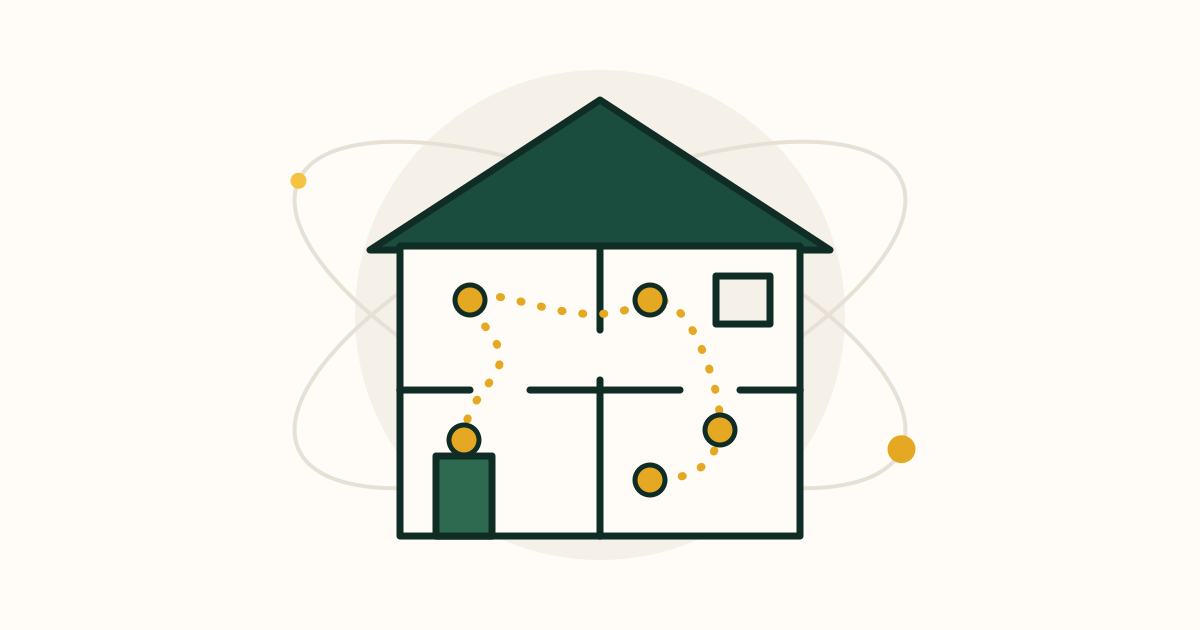
Picture walking in your front door and moving through your home in one direction. Pick 10 specific, distinct spots along that path, in order, for example: 1 front door, 2 coat hook, 3 shoe rack, 4 couch, 5 TV, 6 kitchen sink, 7 fridge, 8 stove, 9 bathroom mirror, 10 bed. Each spot is a (plural loci). Write the 10 down. Choose things that are clearly different from each other; two similar shelves will get mixed up. Avoid jumping back and forth; your route should never cross itself.
Show helpHide help
locus: One stop or location in a memory palace where you place an image. Plural: loci.
Tip: Common mistake: making images too normal. Exaggerate size, add motion, and involve yourself in the scene. Boring images fade within minutes.
Close your eyes and walk through the 10 stops in your mind, seeing each one clearly: the color of the door, the coats on the hook. Say the number and name of each stop out loud. Do it twice forward and once backward, from the bed back to the front door. You have it when you can list all 10 stops in both directions without peeking at your notes. If one stop is fuzzy, swap it for something more memorable nearby. This route is your memory palace and you can reuse it for every list you ever memorize.
Show helpHide help
Tip: Common mistake: making images too normal. Exaggerate size, add motion, and involve yourself in the scene. Boring images fade within minutes.
Here is your practice list, a 10-item shopping list: eggs, bananas, milk, bread, coffee, toilet paper, tomatoes, cheese, batteries, honey. Read it once. Do not try to memorize it by repeating it; the palace will do the work. If you would rather use your own list, write any 10 concrete things, like errands or tasks. Concrete items are easiest at first because you can picture them; abstract words like "patience" need an extra step to turn into a picture.
Show helpHide help
Tip: Common mistake: making images too normal. Exaggerate size, add motion, and involve yourself in the scene. Boring images fade within minutes.
Now walk your route and put one item at each stop as a ridiculous, moving scene, spending about 30 seconds on each. The weirder, bigger and more physical, the better. Examples: eggs are smashing against your front door and dripping down; a bunch of bananas is hanging on the coat hook like a coat and peeling itself; your shoes are full of milk and it sloshes out. Use sound, smell and motion. The common mistake is a plain image, like milk sitting by the shoe rack; that will fade. Make yourself laugh or wince, then move to the next stop.
Show helpHide help
Tip: Common mistake: making images too normal. Exaggerate size, add motion, and involve yourself in the scene. Boring images fade within minutes.
Put your list away. Close your eyes, go back to the front door and walk your route, noticing what is happening at each stop, and say each item out loud. Write them down in order and check against the list: score 1 point for each item in the right place. Most first-timers get 8 to 10 out of 10. If a stop is empty, the image was not vivid enough; go back, make that one more absurd, and try again. Notice how the order comes for free because the route has an order.
Show helpHide help
Tip: Common mistake: making images too normal. Exaggerate size, add motion, and involve yourself in the scene. Boring images fade within minutes.
Now walk from the bed back to the front door and recall the list in reverse, which is almost impossible with but easy with a palace. You did it: you memorized 10 items in order, both ways. Test yourself once more in an hour, and again tomorrow morning without looking; most people still get nearly all of them. Next session, build a second palace at your workplace or a friend's home with 20 stops, and use it to memorize the next 20 items of something you actually need, like a speech outline.
Show helpHide help
rote memorization: Learning by repeating something over and over, rather than by attaching it to images or meaning.
Tip: Common mistake: making images too normal. Exaggerate size, add motion, and involve yourself in the scene. Boring images fade within minutes.
Tips
Common mistake: making images too normal. Exaggerate size, add motion, and involve yourself in the scene. Boring images fade within minutes.
Keep your route one-way and in a fixed order. Never reshuffle stops once you have chosen them.
Reuse the same palace for different lists. New images overwrite old ones after a day or two.
Turn abstract words into pictures with sound-alikes, like "justice" becoming "just ice", a block of ice in a judge's robe.
Glossary
- locus
- One stop or location in a memory palace where you place an image. Plural: loci.
- method of loci
- The formal name for the memory palace technique, from the Latin for "places".
- rote memorization
- Learning by repeating something over and over, rather than by attaching it to images or meaning.
Communities
Resources
Frequently asked questions
Do I need a good memory to start?
No. The technique works with ordinary memory because it uses your strong spatial and visual memory instead of memory for lists.
Can I use a place other than my home?
Yes. Any place you know well works: your workplace, school, a childhood home or a regular walking route.
Will old images get in the way of new lists?
They fade after a day or two. If you need to memorize lists back to back, use a different palace for each.
What is this useful for?
Shopping and to-do lists, speech outlines, vocabulary, names in a meeting, and study facts in a specific order.
How do memory champions memorize cards?
They assign a fixed image to every card in advance and place two or three images at each stop in very large palaces. It is the same method you used, practiced a lot.
Something off in this guide?